
There is / There are
Каждый изучающий английский язык мечтает разговаривать бегло и грамотно. И чем скорее тем лучше. Но не секрет, что изучение языка требует времени терпения и огромной мотивации. Овладение базовыми конструкциями и доведение их до автоматизма и, как следствие, спонтанное использование, повысят не только умение говорить, но и мотивацию.
В этом уроке мы разберем ещё одну базовую конструкцию there is / there are. Эта конструкция используется, когда нам необходимо сказать, что что-то где-то находится.
Например: На столе есть ложка
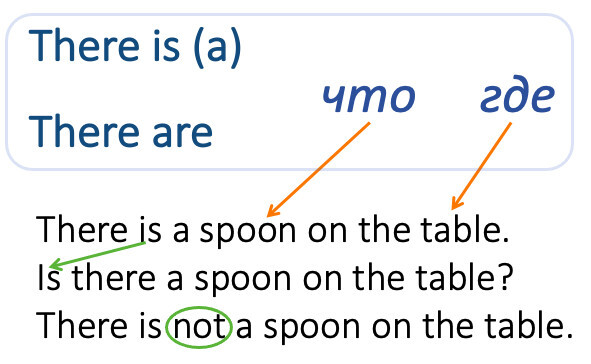
Это предложение начинается со слова, отвечающего на вопрос «где», когда что-то где-то находится мы используем оборот there is/ there are. Предложения с этим оборотом строятся следующим образом:
1. There is a или there are
2. Что находиться
3. Где это находится.
При использовании этой конструкции необходимо помнить некоторые нюансы:
- выбирать оборот нужно, опираясь на существительное следующее сразу после оборота. Если существительное после оборота в единственном числе, то оборот будет в единственном числе, даже если существительных два или три.
There is a spoon, fork and knife on the table. - Если существительные относятся к одной категории, то артикль можно ставить только перед первым существительным, а перед остальными существительными его можно опустить. Но если существительные из разных категорий, то артикль лучше поставить перед каждым из них.
There is a pen, pencil and rubber in the pencil case.
There is a spoon, a pen and a piece of bread on the table. - Если существительное следующее сразу после оборота неисчислимое (его нельзя посчитать), то используем оборот в единственном числе т.е. There is даже если в предложении есть слово «много».
There is a lot of juice in the carton. - В отрицательных предложениях с there is / there are не используется «and» а используется «or» или «with» вместо него.
There is not an apple or a knife on the table.
There is not a table or a chair in the room.
Отрабатывая эту конструкцию рекомендую запомнить ещё два простых, но не менее важных правила:
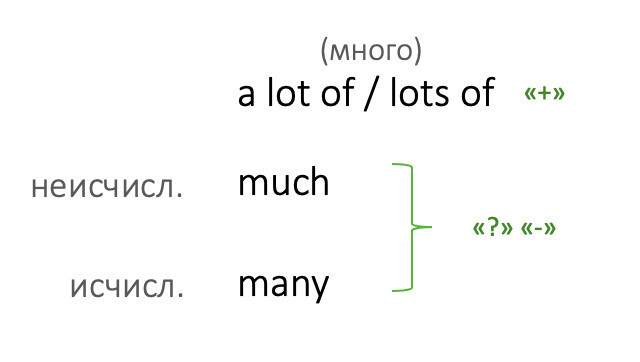
1. В английском существует множество вариантов для перевода слова «много» , например «a lot of», «much» или «many». A lot of используется только в утвердительных предложениях, в то время как much и many используется в вопросе и отрицании. Выбирая much или many необходимо определить можно ли посчитать существительное перед которым оно стоит.
Если существительное исчисляемое (его можно посчитать) то перед ним ставим many, но если существительное неисчислимое (его нельзя посчитать) то перед ним ставим much.
В их команде много мальчиков.
There are a lot of boys in their team.
Are there many boys in their team?
There are not many boys in their team.
В морозилке много мяса.
There is a lot of meat in the freezer.
Is there much meat in the freezer?
There is not much meat in the freezer.
2. Если существительное во множественном числе или неисчислимое, перед ним нельзя поставить артикль «a»/«an». Вместо артикля мы ставим some или any. Some в утвердительных предложениях, any в вопросительных и отрицательных.

There are some interesting ideas to toy with.
Are there any interesting to play with?
There are not any interesting ideas to play with.
Упражнения скачать pdf

1. Посмотрите на картинку. Вставьте there is a / there is some / there are some.
- _____________ fish in the fridge.
- _____________ eggs.
- _____________ carrots.
- _____________ honey.
- _____________ bananas.
- _____________ apples.
- _____________ piece of cake.
- _____________ milk.
- _____________ chicken.
- _____________ sausage.
2. Поставьте слова в правильном порядке.
- my / in / town / a / is / there / cinema.
- two / in / town / hospitals / are / there / my.
- any / our / there / in / village / aren’t / factories.
- do / to / there / a lot of / are / things / on / weekend / the.
- bars / bag / my / chocolate / are / some / there / in.
- the / next to / there / is / hotel / bank / a?
- your / town / university / there / a / is / in?
- people / aren’t / there / here / many.
- week / in / seven / are / there / a / days.
- 10) sit / there / down / nowhere / to / is.
3. Вставьте is/isn’t/are/aren’t/was/wasn’t/were/weren’t/will be.
- There _____ four rooms in my new flat.
- We stayed in a very small hotel. There _____ only ten room.
- There _____ an accident yesterday.
- There _____ a lot of people here on Friday.
- The bottle _____ empty. There _____ any water in it.
- Five years ago there _____ a big shopping centre. Now there _____ any shoppings centers in this town.
- We _____ disappointed with our hotel. There _____ a swimming pool.
- We need to do the shopping. There _____ nothing in our fridge.
- There _____ any milk left in the fridge. I can’t make an omelette.
- There _____ any bananas in the shop yesterday.
4a. Выберите is или are
1) There ___ some bread on the table.
2) There ___ a big mirror and a sink in the bathroom.
3) There ___ a lot of strawberries on the plate.
4) There ___ a lot of flour in the bowl.
5) There ___ some salad left.
6) There ___ a lot of work to do.
7) There ___ some essays to check.
8) There ___ two beds and a mirror between them in the bedroom.
9) There ___ a lot of jam in the jar.
10) There ___ a lot of mushrooms in the forest in autumn.
11) There ___ a slice of bread on the table.
4b. Сделайте предложения из упражнения 4a вопросительными.
Например: Is there any bread on the table?
4c. Сделайте предложения из упражнения 4a отрицательными.
Например: There is not any bread on the table.
Ответы
1. 1)there is a, 2)there are some, 3)there are some, 4)there is some, 5)there are some, 6)there are some, 7)there is a, 8)there is some, 9)there is a, 10)there is a.
2. 1)There is a cinema in my town. 2) There are two hospitals in my town. 3) There aren’t any factories in our village. 4) There are a lot of things to do on the weekend. 5) There are some chocolate bars in my bag. 6) Is there a bank next to the hotel. 7) Is there a university in your town? 8)There aren’t many people here. 9) There are seven days in a week. 10) There is nowhere to sit down.
3. 1)are, 2)were, 3)was, 4) will be, 5)was, wasn’t 6)was, aren’t, 7)wasn’t, 8)is, 9)isn’t 10)weren’t.
4a. 1)is, 2)is, 3)are, 4)is, 5)is, 6)is, 7)are, 8)are, 9)is, 10)are, 11)is.
4b. 2) Is there a big mirror and a sink in the bathroom? 3) Are there many strawberries on the plate? 4) Is there much flour in the bowl? 5) Is there any salad left? 6) Is there much work to do? 7) Are there any essays to check? 8) Are there two beds and a mirror between them in the bedroom? 9) Is there much jam in the jar? 10) Are there many mushrooms in the forest in autumn. 11) Is there a slice of bread on the table?
4c. 2) There is not a big mirror or a sink in the bathroom. 3) There are not many strawberries on the plate. 4) There is not much flour in the bowl. 5) There is not any salad left. 6) There is not much work to do. 7) There are not many essays to check. 8) There are not two beds with a mirror between them. 9) There is not much jam in the jar. 10) There are not many mushrooms in the forest in autumn. 11) There is not a slice of bread on the table.